Currently Empty: $0.00
Digital Survival
Avoiding the U.S. Survival Precipice (the so-called ‘Kill Line’)
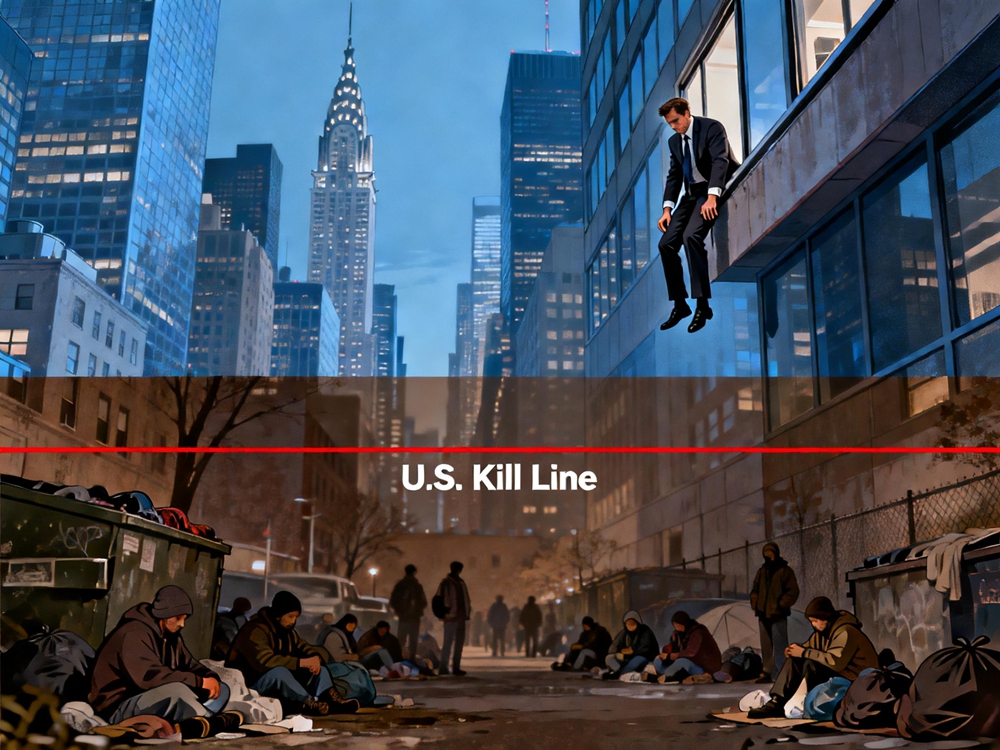
How Individuals Can Prevent Collapse—and How Digital Knowledge Monetization Creates a Path Back
In recent years, the term “U.S. Survival Precipice” has emerged as a globally discussed social concept. Borrowed from gaming terminology, it now describes a harsh real-world threshold: once an individual’s finances, credit, or access to essential living resources fall below a certain line, systemic mechanisms within American society accelerate their decline—from a normal life into homelessness and long-term poverty.
This is not a theoretical risk. From Seattle software engineers earning USD 450,000 annually who became homeless within months of layoffs, to former public figures and child actors losing stable housing, real cases demonstrate how quickly the descent can happen. In a system with limited buffers and high rigid costs, falling below the Survival Precipice often means the loss of housing, employment opportunities, credit access, and ultimately social visibility.
Understanding what pushes people over the edge, and more importantly how to avoid or climb back above it, has become a matter of personal survival. At the same time, the rise of the internet, digital tools, and AI-powered productivity has created alternative survival paths—low-cost, borderless, and less dependent on traditional institutions. Platforms such as eBooksForest illustrate how these tools can be transformed into practical lifelines.
I. The Structural Reality of the U.S. Survival Precipice
The Survival Precipice is not caused by individual failure. It is the result of multiple systemic pressures interacting at once. When one pillar collapses, the others often follow.
1. Medical Debt: The Most Common Trigger
The U.S. healthcare system combines world-class technology with extreme financial risk.
- Over 14% of adults remain uninsured
- Among the insured, most face deductibles exceeding USD 3,000
- Ambulance transport can exceed USD 5,000
- Minor surgeries frequently reach USD 10,000–12,000
Federal Reserve data suggests that one quarter to one third of U.S. bankruptcies are linked to medical expenses. Even middle-class families with insurance can cross the Survival Precipice after a single serious illness.
2. Employment Fragility in an At-Will System
Under the U.S. at-will employment model, job loss can occur without cause or severance. Combined with gig-economy instability, income security has weakened dramatically.
Unemployment benefits:
- Limited to roughly 26 weeks
- Often under USD 400 per week
These benefits rarely cover rent, insurance, transportation, and food. A short income interruption can therefore trigger immediate housing and credit crises.
3. Credit Collapse as a Chain Reaction
In the United States, credit scores function as a second form of identification.
Credit damage can result in:
- Rental rejections
- Loan and financing denial
- Employment barriers
- Loss of access to basic services
Once housing is lost, the lack of a fixed address further compounds exclusion, creating a downward spiral that is extremely difficult to reverse.
4. Rising Rigid Costs and Shrinking Margins
Between 2020 and 2025:
- Rents rose by approximately 38%
- Incomes increased by only 12%
For low-income and middle-income workers, housing alone often consumes more than 50% of total income. Under such conditions, even minor disruptions—car repairs, illness, or reduced work hours—can push individuals over the edge.
II. Personal Survival Strategies: Staying Above the Precipice
While systemic reform is slow, individuals must build their own defensive structures.
Key strategies include:
- Maintaining 6–12 months of emergency savings
- Limiting high-interest consumer debt
- Diversifying income sources
- Protecting credit integrity
- Continuously upgrading employable skills
However, for those who have already slipped close to—or below—the Survival Precipice, traditional advice such as “find another job” often no longer applies.
This is where digital survival pathways become critical.
III. Digital and AI Tools as Survival Infrastructure
The internet enables economic participation without many of the traditional gatekeepers that exclude people in crisis.
Digital advantages include:
- Low startup costs
- Global reach
- Time flexibility
- Independence from local labor markets
AI tools further reduce barriers by assisting with content creation, skill acquisition, and cost management. Together, these technologies allow individuals to generate value even under constrained conditions.
Yet technology alone is not enough. The key question becomes:
What assets can individuals still leverage when jobs, housing, and credit are gone?
IV. eBooksForest and the Path Out of the Survival Precipice
Turning Experience into Digital Assets
Public narratives often portray homeless individuals as unskilled or incapable. Reality tells a different story.
A significant proportion of people who fall into homelessness were once:
- Software engineers
- Construction workers
- Healthcare professionals
- Veterans
- Educators
- Freelancers and consultants
They did not lose their knowledge or experience—they lost the institutional channels through which that knowledge could be monetized.
The real tragedy is not the loss of ability, but the loss of access to economic conversion mechanisms.
This is precisely the gap that eBooksForest addresses.
1. Knowledge Is Not Lost—It Is Trapped
In traditional systems, expertise is tightly bound to:
- Employers
- Physical locations
- Credit histories
- Full-time availability
Once these are gone, individuals are effectively erased from the economy. Yet in a knowledge economy, experience itself is a production asset.
What is missing is a bridge.
2. Knowledge Productization: From Lived Experience to Income
eBooksForest enables individuals to transform fragmented experience into structured, sellable digital products, such as:
- Practical how-to guides
- Industry playbooks
- Career transition manuals
- Survival and risk-avoidance handbooks
- Skill-based tutorials
These products share critical characteristics:
- Created once, sold repeatedly
- No inventory or logistics
- No geographic or time constraints
For individuals facing unstable living conditions, this model is uniquely suitable.
3. Why eBooksForest Works in Survival-Level Scenarios
Extremely low barriers to entry
- No upfront capital
- No reliance on social media influence
- No technical background required
Global digital distribution
- Income is not limited by local economic collapse
- Access to higher-purchasing-power markets worldwide
Near-zero marginal cost
- Each additional sale requires no additional labor
- Income can continue even during personal disruption
Copyright and revenue protection
- Essential for vulnerable creators who cannot afford exploitation
4. Empowering Others as a Form of Self-Rescue
There is a powerful but often overlooked dynamic at work:
Teaching others how to avoid collapse can help pull the teacher back from it.
When individuals who have experienced systemic failure document:
- Mistakes to avoid
- Structural risks
- Practical coping strategies
They reduce the cost of failure for the next generation—while rebuilding their own economic agency.
In some cases, this process becomes the very mechanism that lifts individuals back above the Survival Precipice.
5. From System Exclusion to System-Independent Survival
eBooksForest does not promise wealth or ease. What it offers is more fundamental:
- Choice
- Time flexibility
- Dignity
In a society where losing once can mean losing everything, the ability to convert experience into independent digital assets provides a second survival curve.
Those who can transform knowledge into assets regain something essential:
the ability to participate economically without permission.
And in a system defined by “winner stays, loser exits,” that ability can mean the difference between permanent collapse and recovery.
Conclusion
The U.S. Survival Precipice is not merely an economic concept—it is a structural risk embedded in modern life. Avoiding it requires proactive defense, diversified income, and digital adaptability.
For those already near or below the edge, platforms like eBooksForest demonstrate that survival does not have to depend solely on employment, location, or institutional approval. Knowledge, when properly structured and distributed, can become both protection and rescue.
In an unforgiving system, the power to turn experience into assets may be the most realistic form of modern survival.
Author Profile

- Sean Lee - Founder of the eBooksForest platform, a 16-year veteran freelancer and digital nomad, and an expert in knowledge-based digital publishing.
Latest entries
 Digital PublishingJanuary 23, 2026Free eBook Publishing Sites: How to Publish and Distribute Your eBook at No Cost
- Ebook WritingJanuary 22, 2026Why We Still Need E-books in the AI Era: 6 Truths About Knowledge Assetization
- Ebook WritingJanuary 21, 2026《The Psychology of Money》Morgan Housel on Writing: Why Everyone Should Learn to Write Clearly
- Ebook CreationJanuary 20, 2026How to Create an eBook to Sell: A Complete Guide for Independent Authors