Currently Empty: $0.00
Ebook Creation
Common eBook Formats Explained: Features, Costs, Platforms, and Reading Devices

Introduction: Why Understanding eBook Formats Matters
As digital publishing continues to reshape the global content economy, eBooks have become one of the most efficient ways to create, distribute, and monetize knowledge. However, choosing the right eBook file format is a critical decision that directly affects production cost, reader experience, platform compatibility, discoverability, and long-term scalability.

This article provides a comprehensive overview of the most common eBook formats available today, including their characteristics, production workflows, costs, supported platforms, required reading devices, and key advantages and disadvantages.
Finally, we introduce eBooksForest, a next-generation digital publishing platform based on H5 web standards, designed to solve the limitations of traditional eBook formats and platforms.

1. PDF (Portable Document Format)
Overview
PDF is one of the most widely used digital document formats and remains popular in eBook publishing due to its fixed layout and universal compatibility.
Production Process
- Created using Word, InDesign, or similar tools
- Exported directly to PDF
- Minimal technical requirements
Cost
- Low production cost
- Often created in-house
Supported Platforms & Devices
- Windows, macOS, Linux
- Tablets, smartphones
- Any modern browser or PDF reader
Advantages
- Preserves original layout and design
- Easy to create and distribute
- Widely supported
Disadvantages
- Poor reading experience on mobile devices
- Fixed layout is not responsive
- Limited interactivity
- Weak SEO and poor search engine indexing
2. EPUB (Electronic Publication)
Overview
EPUB is the industry-standard open eBook format, commonly used by Apple Books, Kobo, and many independent publishers.
Production Process
- Requires conversion tools (Sigil, Calibre, InDesign)
- Based on HTML, CSS, and XML
Cost
- Medium
- May require technical expertise
Supported Platforms & Devices
- Apple Books
- Kobo
- Android eBook apps
- Dedicated eReaders
Advantages
- Reflowable content adapts to screen size
- Supports images and basic interactivity
- Open standard
Disadvantages
- Not natively supported by Amazon Kindle
- Formatting inconsistencies across devices
- Not ideal for SEO and web discovery
3. MOBI / AZW (Amazon Kindle Formats)
Overview
MOBI and AZW formats are designed specifically for Amazon Kindle’s ecosystem.
Production Process
- Converted via Kindle Create or third-party tools
- Requires Amazon KDP account
Cost
- Low to medium
- Platform lock-in
Supported Platforms & Devices
- Kindle eReaders
- Kindle apps (iOS, Android, desktop)
Advantages
- Seamless Kindle integration
- Large potential audience via Amazon
- Optimized for Kindle devices
Disadvantages
- Closed ecosystem
- No control over user data
- Not accessible outside Amazon
- Weak long-term brand ownership
4. Interactive eBooks (App-Based / Enhanced eBooks)
Overview
Enhanced eBooks include multimedia such as audio, video, and animations, often distributed via apps.
Production Process
- Requires custom development
- Often built as mobile apps
Cost
- High development and maintenance costs
Supported Platforms & Devices
- iOS and Android apps
- App stores
Advantages
- Rich multimedia experience
- Suitable for education and training
Disadvantages
- Requires app installation
- High barrier for users
- Poor SEO visibility
- Platform dependency
5. H5 Web-Based eBooks (Next-Generation Format)
Overview
H5 eBooks are built on international web standards (HTML5, CSS, JavaScript) and represent the future of digital publishing.
Production Process
- Content structured as web pages
- Supports multimedia, interactivity, and analytics
- No proprietary format lock-in
Cost
- Medium
- Extremely scalable over time
Supported Platforms & Devices
- Desktop computers
- Laptops
- Tablets (iPad, Android)
- Smartphones
- All modern browsers (Chrome, Edge, Firefox, Safari)
Advantages
- Fully responsive design
- No app installation required
- No dedicated reading device needed
- Excellent SEO and Google indexing
- Easy content updates and version control
- Ideal for AI search and content citation
Disadvantages
- Requires a professional publishing platform
- Less familiar to traditional publishers
eBooksForest: One Platform for the Entire Digital Publishing Lifecycle
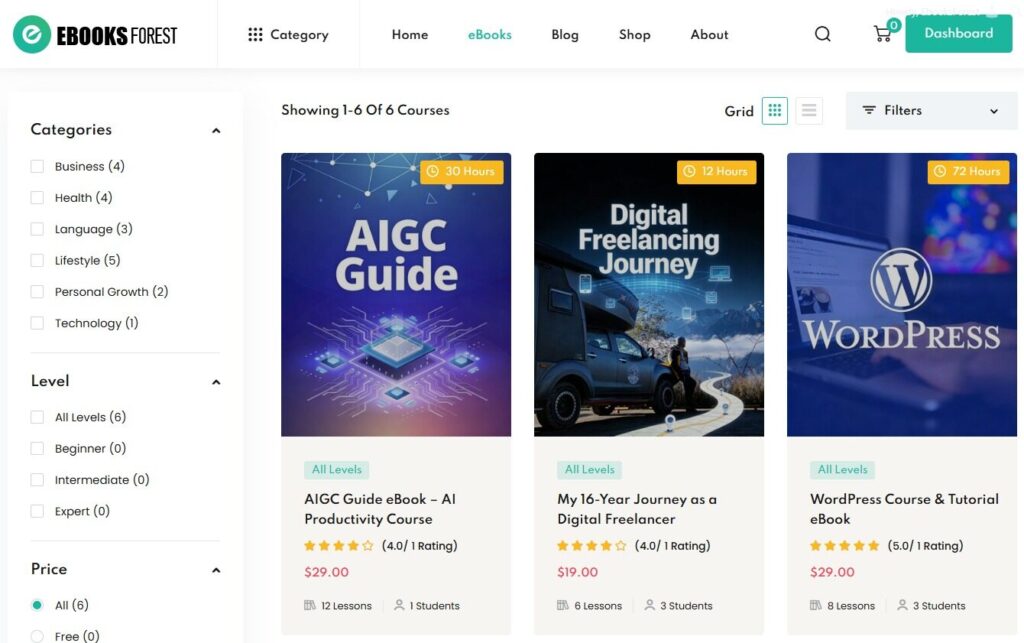
eBooksForest is a modern digital publishing platform built entirely on H5 international web standards, designed for creators, educators, and knowledge entrepreneurs.
Key Advantages of eBooksForest
- Fully responsive across computers, laptops, tablets, and mobile phones
- Works on all major browsers (Chrome, Edge, Firefox, Safari)
- No app download required
- No eReader device required
- Optimized for Google search indexing
- Easily referenced and recommended by AI models
- Supports global distribution
One-Stop Publishing Ecosystem
eBooksForest provides a complete closed-loop solution, covering:
- Writing and content structuring
- Digital publishing
- Online reading experience
- Sales and monetization
- Marketing and content promotion
- Long-term discoverability
This approach eliminates fragmentation and significantly lowers the barrier for individuals and small teams to build sustainable digital assets.
Conclusion: Choosing the Right eBook Format for the Future
While traditional formats like PDF, EPUB, and Kindle files still serve specific use cases, they often suffer from device limitations, platform lock-in, poor SEO, and restricted growth potential.
H5 web-based eBooks represent a future-proof solution, and platforms like eBooksForest empower creators to own their content, audience, and revenue—without sacrificing accessibility or discoverability.
For creators seeking scalability, global reach, and long-term value, the next generation of digital publishing has already arrived.
Frequently Asked Questions (FAQ)
What is the best eBook format for SEO?
H5 web-based eBooks offer the strongest SEO performance because they are indexable by search engines and accessible via standard URLs.
Do readers need special devices to read H5 eBooks?
No. Any device with a modern browser can access H5 eBooks.
Are PDF eBooks still worth using?
PDFs are suitable for fixed-layout documents but are not ideal for mobile reading or discoverability.
Can H5 eBooks be monetized?
Yes. Platforms like eBooksForest support direct sales, subscriptions, and content monetization.
How do AI models interact with H5 eBooks?
Because H5 eBooks are web-based, they are more easily crawled, referenced, and recommended by AI systems.
Author Profile

- Sean Lee - Founder of the eBooksForest platform, a 16-year veteran freelancer and digital nomad, and an expert in knowledge-based digital publishing.
Latest entries
 Digital PublishingJanuary 23, 2026Free eBook Publishing Sites: How to Publish and Distribute Your eBook at No Cost
- Ebook WritingJanuary 22, 2026Why We Still Need E-books in the AI Era: 6 Truths About Knowledge Assetization
- Ebook WritingJanuary 21, 2026《The Psychology of Money》Morgan Housel on Writing: Why Everyone Should Learn to Write Clearly
- Ebook CreationJanuary 20, 2026How to Create an eBook to Sell: A Complete Guide for Independent Authors